
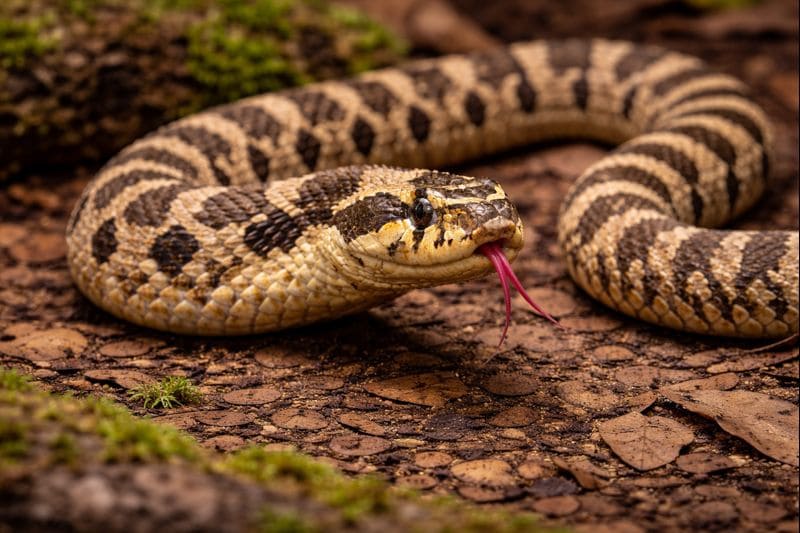
If you’ve ever watched a small snake flatten its neck like a tiny cobra, hiss with theatrical confidence, and then collapse into a convincing “death” scene, you’ve seen the charm of a hognose. These compact reptiles are known for their upturned snouts, which help them burrow through sandy soil in search of prey and safe hiding spots. Despite their bold attitude, most are surprisingly mild-mannered and would rather bluff than bite. For reptile keepers and backyard naturalists alike, hognoses prove that big attitudes can come in small, burrowing packages.
What Makes a Hognose a Hognose?
The name comes from that signature hog nose, an upturned, shovel-like snout designed for digging. Hognoses are semi-fossorial, meaning they spend a lot of time under loose substrate, leaf litter, or sand. Their bodies are stocky, their scales often have extra texture for traction, and their instincts are tuned for finding cover fast.
But what most people remember isn’t anatomy—it’s the performance. When threatened, many hognoses start with intimidation: loud hissing, a flattened neck, and repeated bluff strikes meant to scare rather than harm. If the danger doesn’t leave, some individuals switch tactics and “play dead,” rolling over, gaping their mouths, and lying still. If you flip them upright, they may flip right back over, as if staying in character is the safest plan.
In the wild, diet varies by species and region, but amphibians—especially toads—are a frequent menu item. Some species have mild, rear-fanged venom that assists with subduing prey; for humans, it’s typically not medically significant, but any bite should still be treated seriously and handled with basic first aid.
Eastern and Western Hognoses: Similar Vibe, Different Neighborhoods
Two of the most talked-about varieties are the eastern hognose and what keepers often call the western hog nose. The eastern hognose is native to parts of the eastern United States and is commonly associated with sandy woods, coastal plains, and open areas where toads are plentiful. It’s also known by an old-fashioned nickname: the eastern bullnose snake, a nod to its stout body and bold “I’m bigger than I look” attitude.
The western hog nose is often smaller on average and popular in captivity because it tends to adapt well to human care. In nature, it’s tied to drier, open habitats—prairies, plains, and sandy scrub—where burrowing helps with temperature control and predator avoidance.
To identify them, look for a combination of traits: the upturned snout, the sturdy build, and the classic bluff display. No single clue is perfect on its own, but the overall hognose profile is distinctive once you know what to watch for.
Vivariums and Care Basics for a Happy Hog Snake
If you’re considering a hog snake as a pet, design the enclosure around what the animal naturally does: dig, hide, and explore in short bursts. That means emphasizing floor space and providing a deep, diggable substrate that holds tunnels. Many keepers choose vivariums because they can maintain stable heat, allow a clean setup, and support a simple, naturalistic layout.
A temperature gradient is crucial—warm on one side, cooler on the other—so the snake can thermoregulate. Provide at least two secure hides (one on each end), plus additional cover like cork bark or low tunnels. Because hognoses are stress-sensitive, an exposed enclosure can lead to constant hiding and skipped meals, while a well-structured setup often results in a confident snake that surfaces regularly.
Feeding should be consistent and species-appropriate. Captive-bred animals commonly accept frozen-thawed rodents, but some hognoses can be picky, especially when newly relocated. Keep conditions steady, minimize handling right after feeding, and let the snake feel secure. If appetite drops, check husbandry first—temperatures, hiding options, and stress.
Handling should be calm and brief, particularly in the early weeks. Expect hissing and bluff strikes at first; those behaviors often fade when the snake learns it isn’t in danger. Support the body, avoid sudden movements, and end sessions before the animal becomes overwhelmed.
Conclusion
Hognoses are a blend of practical adaptation and unforgettable drama: a digging snout, a burrowing lifestyle, and defensive acting that relies more on performance than aggression. Whether you admire an eastern hognose in sandy woodland habitat or keep a western hog nose in a thoughtfully arranged home setup, these reptiles reward patience, observation, and respect. With well-designed vivariums that support digging and hiding, plus steady routines that reduce stress, a hognose can become one of the most entertaining snakes to observe up close.